

The Path Toward a Bitcoin Standard
Digital Credit’s First Real Stress Test

Dear Bitcoiners,
During this bear market bottom formation, treasury companies are being heavily criticized, even though they have been the main source of demand. Some of the critique is fair. Digital Credit was marketed as lower volatility, yet STRC traded all the way down to $82, roughly 18% below its $100 par value.
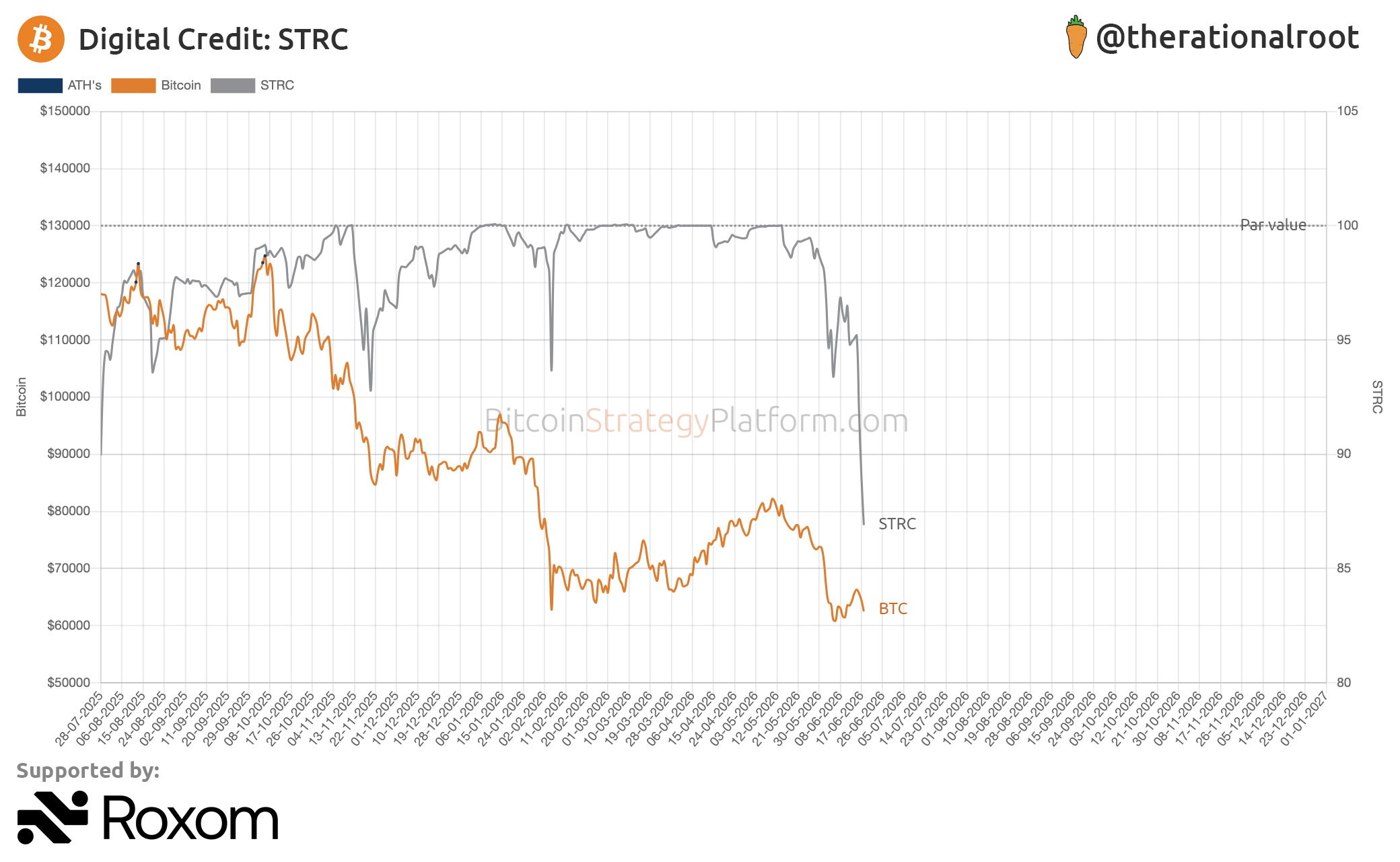
This is Digital Credit’s first real stress test: it’s still less than a year old, leveraged STRC positions are unwinding while Bitcoin is undergoing its bottom formation, and there is competition for liquidity from AI and IPOs.
This week, Digital Credit got declared “dead.” Bitcoin itself has been declared dead countless times, especially during the deepest parts of bear markets, when sentiment-driven fear and panic are at their peak.
👉 Key insight: it is extremely unlikely that STRC fails here. Strategy has a cash balance to pay dividends for at least 7 months, and a Bitcoin reserve to pay dividends for decades.
What Is Digital Credit?
Digital Credit is a TradFi product, preferred equity, backed by Bitcoin on the company’s balance sheet. The goal is to strip out most of Bitcoin’s volatility and convert it into income through dividend payments.
My usual work focuses on market analysis: using on-chain data to assess price, risk, and cycle positioning. In last week’s newsletter, we discussed the low consolidation phase and a bottom prediction. That newsletter remains highly relevant. If you haven’t read it yet, you can find it here:

This week, I want to discuss the forces of capital entering Bitcoin, in particular Bitcoin treasury companies and their role in the path toward a Bitcoin standard.
I’ve mentioned several times that this cycle’s main sources of demand have been ETFs and treasury companies. Both are fiat constructs, hence the critique from the community. And while some of that critique is justified, I hope to clarify how these constructs are actually a natural part of the transition toward a Bitcoin standard.
Unlock access to the Bitcoin Strategy Platform with all premium curated live charts and indicators. Claim your 25% lifetime discount today!
The Path Toward a Bitcoin Standard
There is a strong part of the community that thinks Bitcoin should remain a parallel system. The view is: “We’re supposed to be against the banks.” Bitcoin should be about self-custody. They are against the idea of ETFs and treasury companies, and against fiat constructs in general. Their view is that the righteous path toward a Bitcoin standard is opting out of fiat.

But we don’t get to choose the path toward a Bitcoin standard. Bitcoin is about game theory and incentives. Whether you like treasury companies or not, they are here, and they are one of the main sources of demand for Bitcoin, especially during this bear market.
I admire the rejection of fiat constructs. We come from a system that is corrupt and has deceived us. Bitcoin is about truth and fairness.
However, one has to realize that many fiat constructs came into existence because of a real need. Banks serve a purpose in society. And even though they are able to create money out of thin air, for example through mortgages, that same mortgage is also a financial service for which there is demand.
It is absolutely no surprise to me that these services are being reinvented on Bitcoin. For example, my sponsor Roxom allows you to open a 7.25% APR credit line. But unlike an unsecured fiat loan, it is collateralized by Bitcoin, without rehypothecation.
What I am getting at is that banks are not necessarily the core problem, as these same concepts are emerging on a Bitcoin standard. The real problem is the incentives.
For over 50 years, we’ve been on a fiat standard. Because of a monopoly on money, governments have been able to gain ever more control over our lives. Fiat expands state capacity and normalizes intervention. When governments monopolize the money printer, they can fund endless bureaucracy, subsidies, enforcement, and public-private influence without asking citizens for explicit taxes. Over decades, that normalizes dependence and lets the state steer public opinion. The side effects of money printing lead to inflation, and because of inflation we need ever more intervention. It is a flywheel.
As a result, a lot of capital is trapped in decades of rules and regulation.
Bitcoin is the solution to this problem, but how does the trapped capital move into Bitcoin? You might have guessed it: through integration with the fiat system.
ETFs are one such example. Treasury companies are another.
👉 Key insight: Bitcoin is not being captured by the fiat system. It is the trojan horse.
Bitcoin’s game theory and incentives cause treasury companies to emerge, serving as a bridge for capital to flow into Bitcoin. Integration with the fiat system is important, because it helps unwind decades of trapped capital and lets it flow toward Bitcoin. The emergence of these fiat constructs, allowing people to gain a percentage-point allocation through a wealth advisor or pension fund, will contribute to a more gradual transition.
Integration with fiat will allow for a much more peaceful transition to a Bitcoin standard. The alternative is letting all that capital remain trapped and get hyperinflated, which would create a much bumpier ride toward a Bitcoin standard.
Treasury companies are called a flywheel because capital flowing into them can be converted into more Bitcoin Per Share (BPS), and rising BPS can attract even more capital.
👉 Key insight: That same flywheel is also the unwind of capital trapped in fiat.
I sincerely hope this helped clarify the dynamics behind treasury companies, and the path toward a Bitcoin standard. I always try to steelman my arguments, so if you disagree or have strong counterarguments, I’d love to read them in the comments. 👊🧡
Until next week, 🫡
-Root