

BIP-110
Chain Split Coming? Spam on Bitcoin.

Dear Bitcoiners,
This week I want to discuss BIP-110, as ongoing discussions within the community have been heating up. As Bitcoin is undergoing its bottom formation, we are also going through an internal war about spam on Bitcoin. I have been following this debate for many months and understand many of the technical arguments but have never publicly spoken out because my position has been fairly neutral.
However, I now feel obligated to discuss my insights and stance, as serious chain-split risk is coming in about 3 weeks, around August 7, or more specifically block height 961,632.
But before we jump into BIP-110, I want to share the links to the latest on-chain bottom formation insights. We have been tracking this bottom formation from many on-chain angles, which gives a clear idea of what is likely to come.
STH Bands: we used Short-Term Holder Bands to determine Bitcoin’s position in the bottom formation. We discussed how we are entering Phase 2, which historically has been close to the actual cycle bottom.
On-Chain Value Map: we compared cycle bottoms and identified the Deep Undervaluation level.
CVDD & Realized Price: we identified the Bottom Formation & Low Consolidation phase, where CVDD takes over as the global floor.
Drawdown in Realized Price: we used the Realized Price to determine a potential worst-case scenario.
Unlock access to the Bitcoin Strategy Platform with all premium curated live charts and indicators. Claim your 25% lifetime discount today!
BIP-110
Bitcoin Improvement Proposal 110 is a proposal that limits the ways of storing arbitrary data in Bitcoin transactions. Its goal is to reduce spam and keep Bitcoin for strictly monetary use. A significant part of the Bitcoin community, including Bitcoin developer Luke Dashjr, is pushing this.
While using Bitcoin for monetary use only is a noble goal, it’s impossible to keep spam from entering Bitcoin as it can even be stored in a hash, indistinguishable from a normal transaction, hence the controversy around BIP-110.
Technically, BIP-110 is a soft fork, it makes the rules stricter. But if it is pushed without broad consensus, it will lead to a chain split. BIP-110 is using a consensus threshold of only 55% to lock in, a very low majority. Current hashrate signaling and prediction markets suggest it’s very unlikely to reach that threshold, meaning early August, unless we still see an overwhelming increase, it could result in a chain split, similar to what happened with Bitcoin Cash in 2017, a minority group splitting away from Bitcoin. Today, Bitcoin Cash (BCH) trades at only a tiny fraction of Bitcoin.
How Did We Get Here?
The debate heated up around the rollout of Bitcoin’s main node implementation Core v30 in October of 2025, where they changed a default relay parameter for OP_RETURN from 83 to 100,000 bytes. OP_RETURN is a transaction output that can be used to store arbitrary data. While there are a lot of nuances to this change (which we’ll get into below), it wasn’t received well by the community. Many Bitcoiners felt like Core was opening the door for more spam. Instead of pausing and listening to the community, Bitcoin Core pushed the change through. This gave momentum to the KNOTS movement, an alternative node implementation keeping the 83-byte standard, and a focus on reducing spam. The main figures behind KNOTS then came with BIP-110.
My Stance
As the main node implementation, Core had the responsibility to work toward consensus and listen to the community and not push through changes, even though they had their technical arguments. Core showed arrogance toward a large part of the community, and handled this very poorly.
The KNOTS movement was therefore a justified pushback and it’s healthy to have alternative node implementations.
I highly value Bitcoin’s monetary use and I do not want spam on Bitcoin. However, spam is impossible to fully stop because data can be hidden in a hash, making it indistinguishable from a normal financial transaction.
Where KNOTS was justified, BIP-110 is committing a worse mistake than Core, pushing a low-consensus soft fork.
👉 Key insight: Core pushed a low-consensus policy change, but BIP-110 pushes a low-consensus soft fork with an immediate chain-split risk.
Spam On-Chain
Before we continue to discuss the differences of the position of Core and the BIP-110 crowd, it’s necessary to first understand the different ways spam enters Bitcoin.
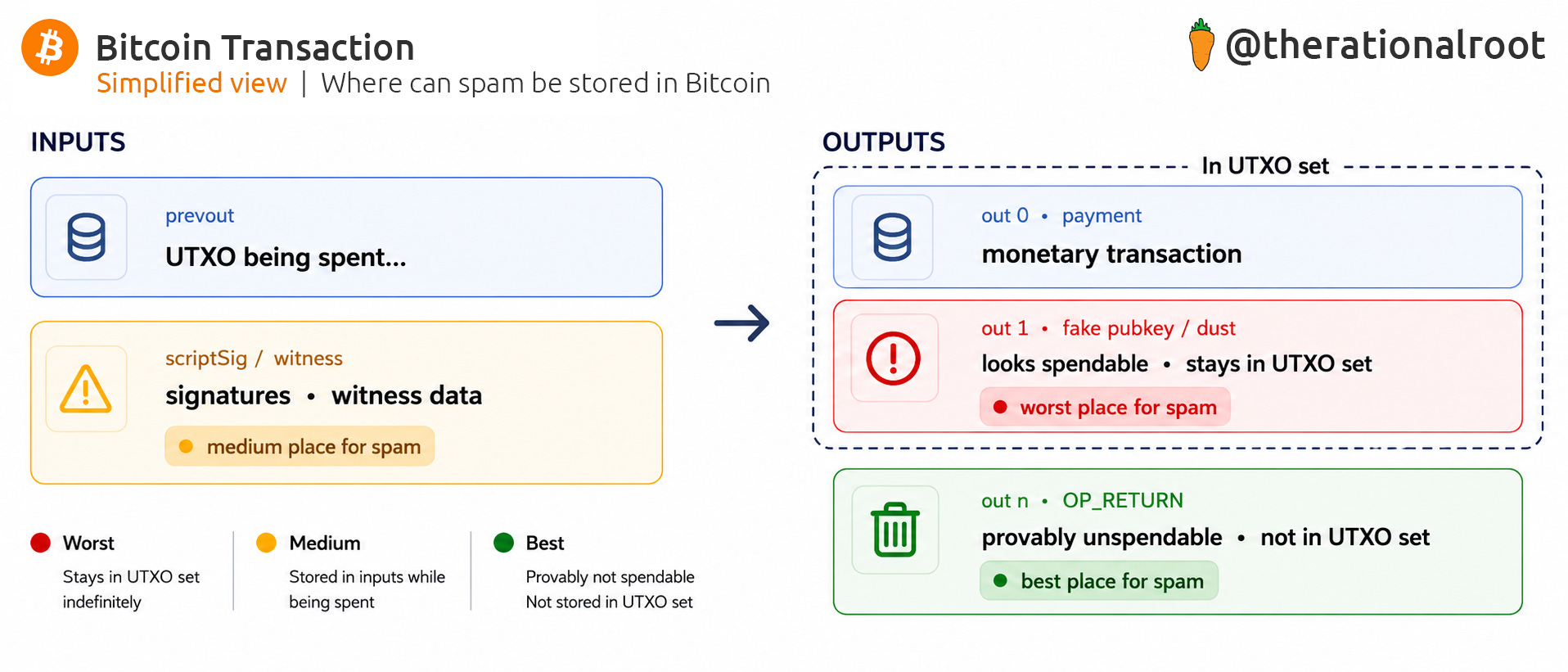
There are different forms of spam on Bitcoin.
Outputs / UTXO set: this is the worst type. These outputs need to be tracked by nodes in the UTXO set and create a lasting burden on nodes.
Witness data: this is where inscriptions mainly live. Witness data is discounted, which makes it cheaper to use for bulk data and can store 400,000 bytes.
OP_RETURN: this is the least harmful place and can carry roughly 100,000 bytes per standard transaction. OP_RETURN outputs are provably unspendable, do not enter the UTXO set, and can be pruned by nodes. OP_RETURN could be seen as a trashcan.
👉 Key insight: Witness data has ~4x more space than OP_RETURN and is cheaper, currently the most attractive way to store spam on Bitcoin. Core v30 did not change consensus, it only changed default relay policy from 83 to 100,000 bytes. This relay policy was already bypassed, as spammers could go directly to miners and have their larger OP_RETURN transactions included in a block.
Position Core
The Core position is basically harm reduction by changing the incentives.
The idea is not that spam is good, but if spam exists anyway, you prefer it in the trashcan instead of putting a burden on all nodes. From that perspective, a bigger OP_RETURN is not pro-spam. It is an attempt to push unavoidable spam into the least harmful place.
There is another important point. Bitcoin’s chain growth is already capped by consensus. Under SegWit, block weight is limited to ~4mb. Spam can fill blocks, but it cannot make blocks grow beyond the maximum allowed size. That does not mean spam is harmless. It means spam is not an infinite storage attack on the chain itself. Spam competes for blockspace like everyone else. Price is the best filter for spam. If monetary demand outbids spam, spam gets priced out. If spam outbids monetary demand, spam pays the fee.
Position BIP-110
The pro-BIP-110 side has a strong moral argument.
Bitcoin is money and not for arbitrary data storage. From their perspective, making OP_RETURN bigger does not solve the problem, it simply gives spam another place to grow. They argue that spammers do not care about using the least harmful place. Some spammers might even prefer the worst place.
Therefore, Bitcoin should signal that spam is not welcome. BIP-110 itself also admits spam cannot be solved, but argues that forcing data to be broken up or hidden strengthens the message that Bitcoin does not support data storage as a use case.
Where the Core side is mostly focused on incentives, BIP-110 is focused a lot on signalling, even though this will become a cat-and-mouse game.
Conclusions
The BIP-110 movement implies there is an immediate threat that needs to be solved with regards to spam. But current spam entering Bitcoin is not nearly at peak levels as we saw during the Ordinal & Inscriptions hype phase. And while ideally we wouldn’t have spam, the growth rate of the blockchain is capped, whether filled with monetary transactions or spam. Hence, there is no immediate threat.
A bigger long-term threat than the size of the entire blockchain is the size of the UTXO set (the set of all unspent transaction outputs). There’s an argument to be made that BIP 110 forces spam to move to the UTXO set instead of the trashcan. Equally there’s an argument to be made on the Core side, it will invite overall more spam.
Core was wrong by pushing low-consensus node implementation policies, but BIP-110 is rushing and forcing a low-consensus soft fork.
Risk of a Chain Split
Ironically, rushing BIP-110 is a bigger immediate risk than spam itself.
· It will likely cause a chain split.
· Exchanges and wallets may pause withdrawals/deposits.
· Users could be confused about which chain they are using.
· There can be replay risk, eg. accidentally spending coins on both chains.
· Miners will waste hashpower on a minority chain.
· The minority chain can be unstable and vulnerable to reorgs.
· It creates market uncertainty and could affect price.
· It divides the community during an already fragile bear-market bottom formation.
· It sets a precedent that a low threshold, or a loud minority, can try to push consensus changes.
Further, BIP-110 specifically could limit future Bitcoin development as it limits several Taproot-related features that affect miniscript, vaults, inheritance setups, lightning channel factories and LN symmetry. The BIP-110 argument is that if these tools are truly valuable for Bitcoin’s monetary use, they can be tested elsewhere first and later be reconsidered for Bitcoin.
Wrap Up
Arbitrary data on Bitcoin cannot be fully stopped. If someone is willing to pay and miners include the transaction, data will find a way.
UTXO spam is the worst.
Witness spam is not ideal, especially because it is discounted.
OP_RETURN is the least harmful place.
I would prefer a future solution where OP_RETURN is economically the best place for unavoidable spam, while witness data and UTXO spam are discouraged. Unfortunately such a solution is likely not possible with just a soft fork.
But a solution should not be rushed, and needs broad consensus. Meanwhile, fees are the most neutral spam filter.
Even though I am unhappy with how Core handled this, from a technical perspective I lean more toward Core’s harm-reduction and incentives approach than BIP-110’s cat-and-mouse approach.
Core was wrong to ignore social consensus, but BIP-110 is committing the same mistake, and worse.
I truly believe most people pushing BIP-110 have good intentions. Unfortunately, a chain split will cause some good people to permanently leave. I hope many stay and we can continue to work toward a high-consensus solution.
The uncertainty and divide can affect Bitcoin’s price, especially now, during the bottom formation, when sentiment is already weak. On the bright side, we will learn a lot from this event. Previous protocol changes were painful, but they helped clarify what Bitcoin is and how hard it is to change. Moving slow is a feature.
I hope this clarifies the ongoing discussion and upcoming events around BIP-110. With good intentions and best effort, I tried to explain the situation as I see it. I hope you found these insights useful. It’s a sensitive topic for many. If you see things differently, your constructive thoughts and opinions are appreciated. 🧡 👊
Until next week, 🫡
-Root
Views are my own.
Supported by Roxom | Bitcoin-denominated capital markets.
Thank you for the even-handed explanation. X has become a minefield of, unfortunately, interpersonal conflict on this issue. I didn't have a firm grip till reading your explanation.
I agree with your position, Root. I wish Core had done it differently but 110 isn't the answer to that.